

Turn Messy Client Notes Into Your Signature Framework
The step-by-step process to extract, name, and sell what you already know

You’re sitting on a goldmine of intellectual property.
It’s buried in call transcripts, scattered notes, old slide decks, and those Slack messages where you typed out advice at 11pm.
Every week, you repeat similar insights to different clients. You solve the same problems with the same approaches.
You have a methodology. You just haven’t named it yet.
This newsletter gives you the exact workflow to pull a Signature System from those messy notes. One that can power your coaching programs, newsletters, courses, and more.
Here’s what this looks like in practice
I recently analyzed one of my own client calls where I helped a technical professional build their coaching business using AI.
The raw transcript was a mess of tool troubleshooting, tangents about network marketing, and back-and-forth about AI tools.
But buried inside were clear patterns.
When I ran the framework, here’s what emerged:
The BRAND Method (what I was actually teaching, without realizing I had a framework):
Baseline Documents: Create 4-5 foundational files that capture everything AI needs to know about your business
Research Your Market: Use deep research tools to identify pain points, score them by importance (1-10), and find gaps competitors miss
Articulate Your Differentiator: Define not just what you do, but why you’re the right person to do it
Navigate Content Through Filters: Every piece of content must address a high-scoring pain point
Deliver Value First: Give away 30-40% of the solution for free; trust earns the transaction
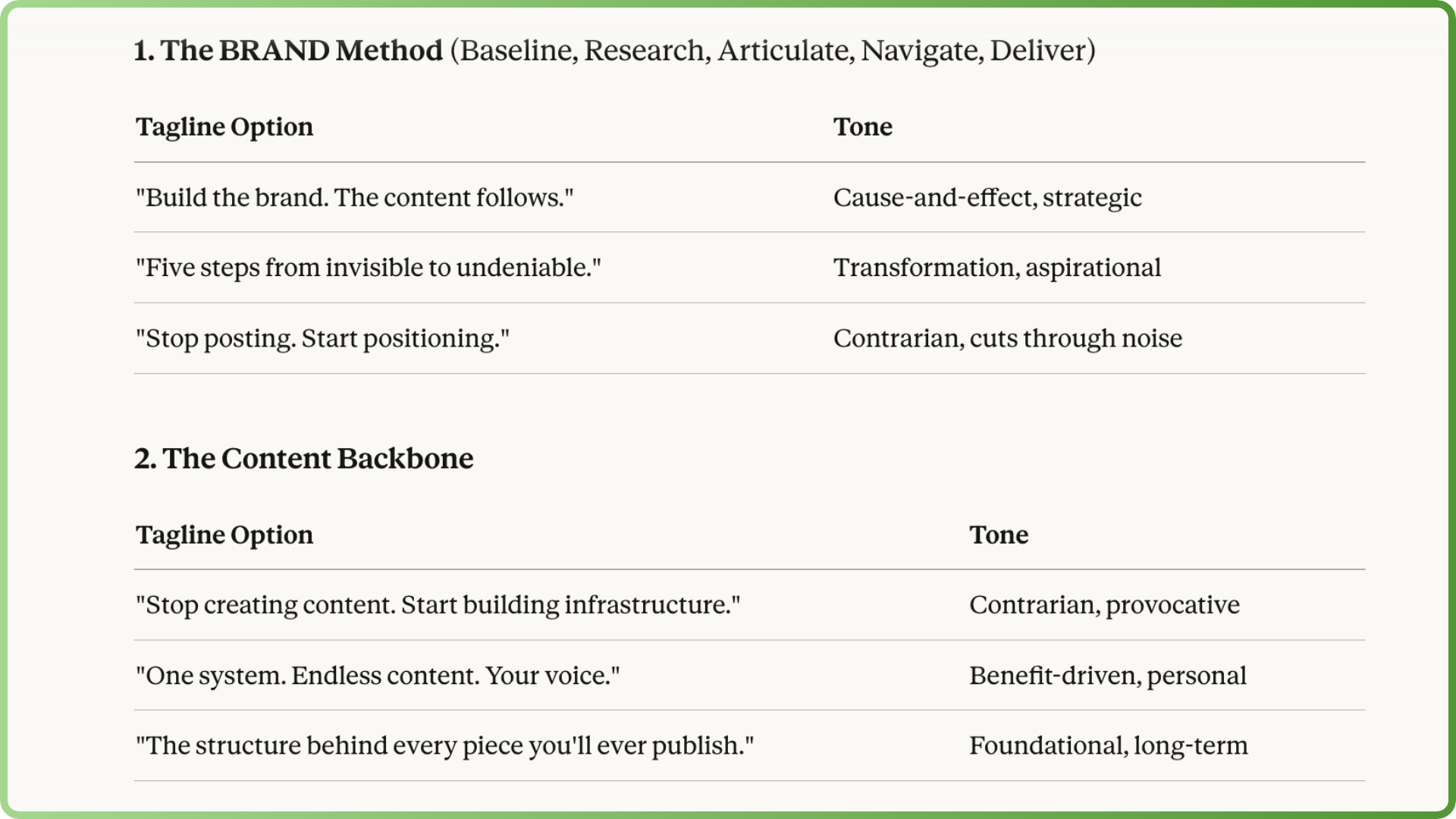
I’d been teaching this for months. I just hadn’t named it until I extracted it from my own transcripts.
That’s what this process does. It surfaces what you already know.
The 45-minute framework to convert messy notes to Signature System
[0:00 – 0:10] Collect and clean
Grab raw text from 2-3 recent client calls or strategy sessions. These could be:
Transcripts from Zoom, Teams, or Otter
Voice memos you transcribed
Detailed notes you took during or after calls
Getting transcripts fast:
This is the least glamorous part. Bear with me. It takes 2 minutes.
Zoom (cloud recording): Go to your recordings, click a meeting, download the VTT transcript file
Microsoft Teams: Open the meeting Recap, download as
.docxor.vttOtter: Click Export, choose TXT or DOCX
Fallback: Copy/paste your notes into a plain text file with headings: Context, Client goal, Key pains, What I recommended
Before you feed anything to AI, replace sensitive information with placeholders:
Client names →
[CLIENT]People names →
[PERSON]Company/product names →
[COMPANY]URLs and emails →
[URL]/[EMAIL]
Save each call as a separate file: CALL_1.txt, CALL_2.txt, CALL_3.txt.
[0:10–0:25] Extract key info
Make sure you turn on the thinking mode of the AI you’re using.
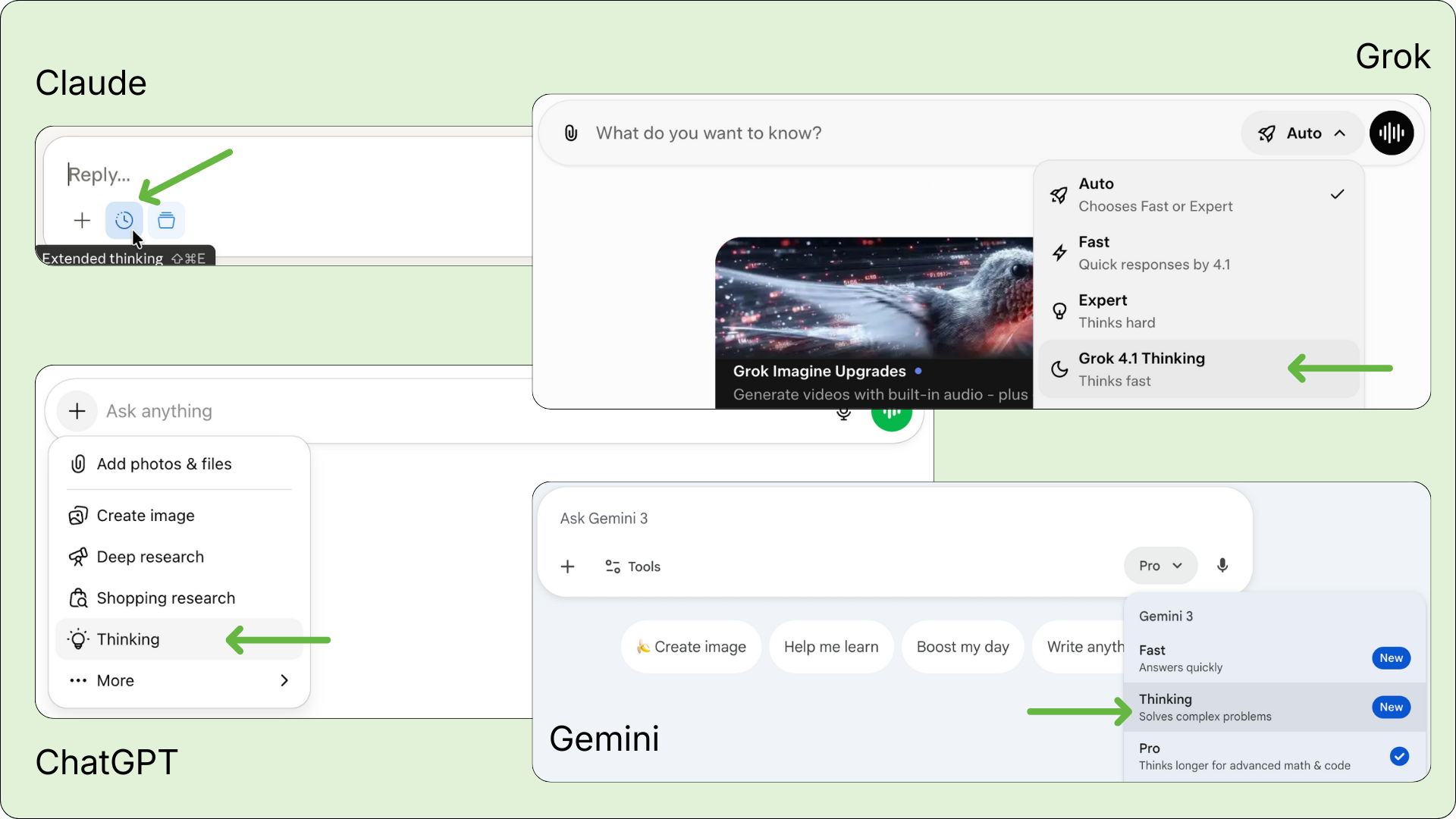
Paste extraction prompt and upload the transcript. Do this for each call separately. This will extract the key claims and quotes.
You are a qualitative analyst. Your task is to extract recurring client problems and the consultant's recommended actions from the uploaded call transcript.

Rules:
- Only use information present in the transcript
- Include direct quotes as evidence for each claim
- Prefer the consultant's actual advice over general best practices

Analyze this transcript and return JSON with:

1. call_summary: 5 bullet points
2. problems: array of objects with {problem_label, problem_description, evidence_quotes:[]}
3. advice_actions: array of objects with {action, when_used, why_it_works, evidence_quotes:[]}
4. implied_process_steps: propose 3-6 steps with {step_name, step_description, evidence_quotes:[]}
5. uncertainties: what's unclear or missing from this call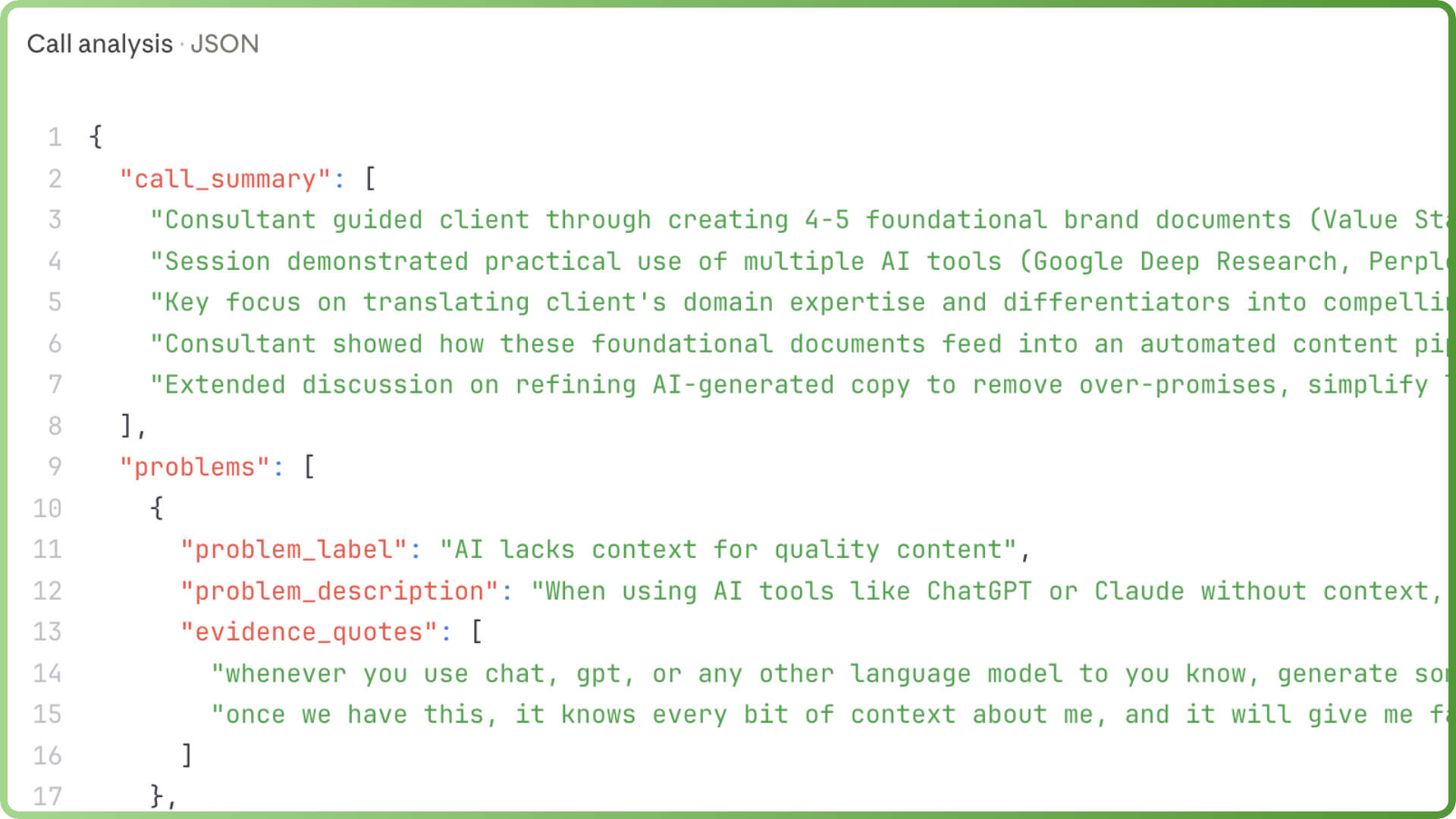
Yes, this works even if your notes are a disaster. The prompt is designed to find signal in noise. You might be surprised what patterns emerge from transcripts you thought were unremarkable.
Download and save all the extracted call analyses from all the calls. We will use them in the next step.
[0:25–0:35] Cross-call synthesis (find the repeatables)
Now we’ll combine the outputs and look for what repeats. Finding patterns across multiple documents is tedious for humans and trivial for AI.
Here’s the synthesis prompt:
You are synthesizing findings from client calls to discover this consultant's repeatable methodology.

Tasks:
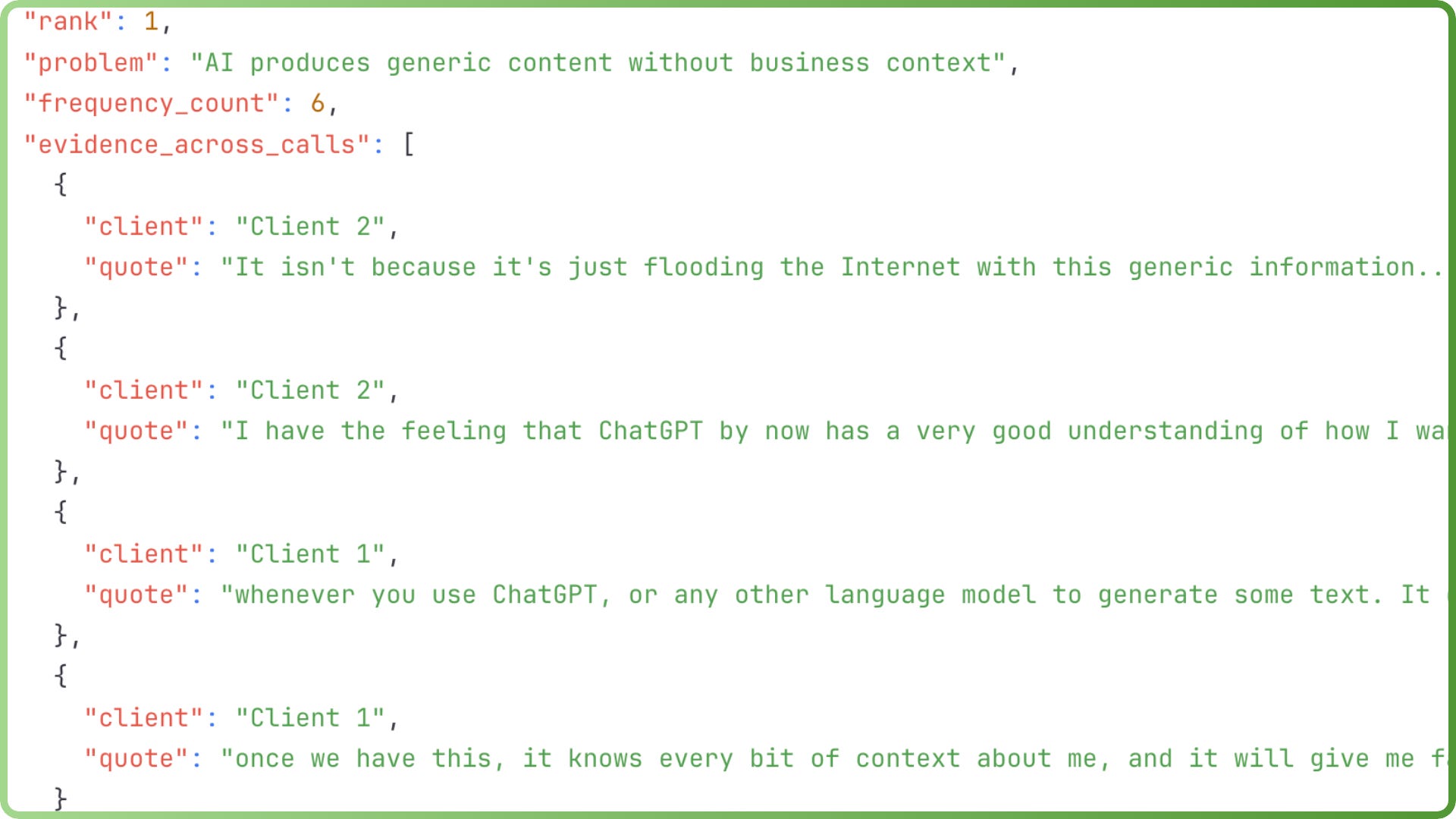
1. Identify the 3 most recurring problems (ranked by frequency, with counts)
2. Infer the single most consistent 4-step process the consultant recommends
3. For each step, provide: purpose, typical client resistance, and 2-3 evidence quotes from different calls
4. Write one positioning sentence: "I help [X] achieve [Y] by doing [Z in 4 steps]..."

Return JSON with:
- recurring_problems_ranked
- signature_process_4_steps (each with: step_name, purpose, client_resistance, evidence_quotes)
- positioning_sentence
- edge_cases (situations where this process might not apply)

I have uploaded the analysis files.
The output gives you the skeleton of your Signature System: the problems it solves, the steps it follows, and evidence that it’s real, not invented.
[0:35–0:40] Name and make it sticky
A framework without a name is just advice. Names create recall. Names get repeated. Names become assets.
There’s research showing that statements with rhythmic or poetic structure feel more memorable and even more true. This isn’t about being clever. It’s about being remembered.
Here’s the naming prompt:
Generate 15 names for this 4-5 step process:
- 5 acronyms (real words preferred)
- 5 alliterative names
- 5 mechanism names (e.g., "The Feedback Flywheel")

Constraints:
- No cringe, no jargon
- Easy to pronounce
- Each step name: 1-3 words
- Use client language from these quotes: [paste 5-10 sticky phrases from your calls]

Return a table: Name | Why it works | Risk/confusion | Best fit audience

Also provide 3 tagline options for the top 3 names.
The “clear over clever” test: If your acronym feels forced, abandon it. It’s always better to be clear than clever.
Pick one name. Then rewrite your step names using your clients’ actual language. The goal is a system that sounds like you, not like it was assembled by committee.
[0:40–0:45] Generate the visual
Two final steps: create a visual and stress-test your framework.
Select your favourite framework and use the following prompt (replace [NAME] with the name of your framework):
Create a Mermaid flowchart for the [NAME] framework.
flowchart TD
  A[Recurring Client Problem] --> B[Step 1: ___]
  B --> C[Step 2: ___]
  C --> D[Step 3: ___]
  D --> E[Step 4: ___]
  E --> F[Outcome: ___]

Output only the Mermaid code block.
The AI will produce a code block like this:
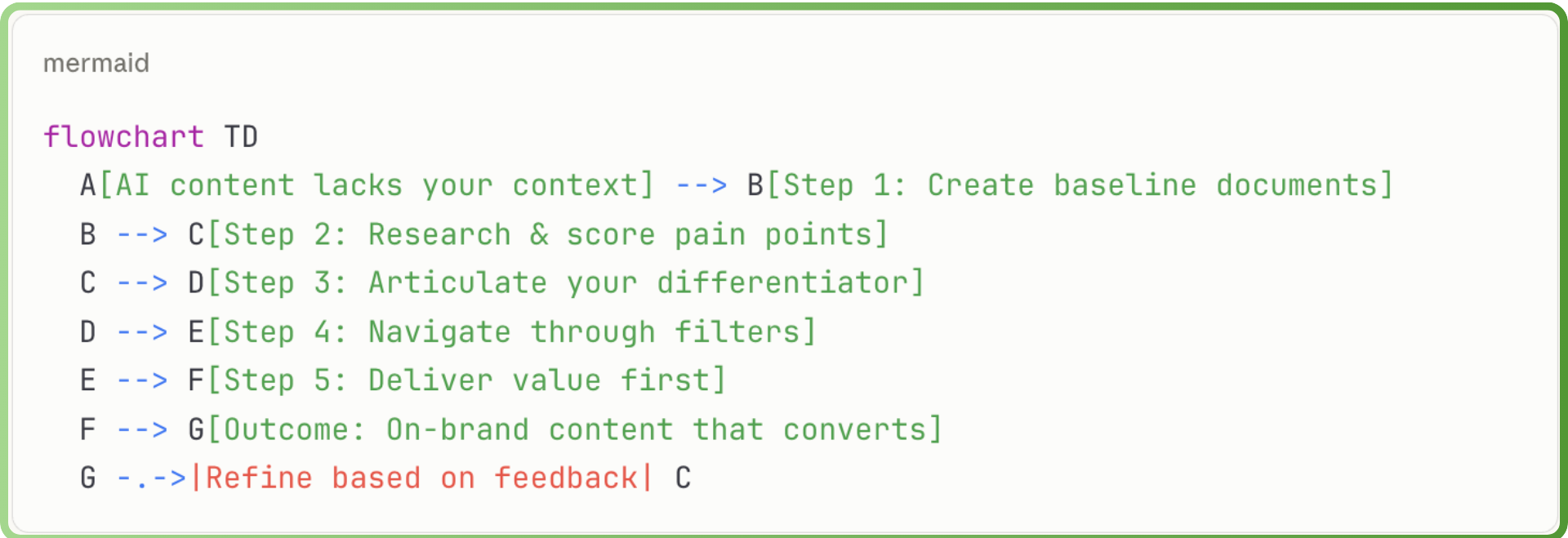
Copy the code block, open mermaid.live, and paste the code block to get your signature framework visual:
Your One-Pager Template
After 45 minutes, you’ve done the hard part. Now you package it.
You should have everything needed to fill out this template:
Signature System One-Pager
Name + Promise: [Framework name]: [One-sentence outcome]
Who it’s for: [Specific client profile in 1-2 sentences]
The 3 recurring problems: [Client language, not consultant jargon]
The 4-step system:
Step 1: [Name] — Goal / Key activity / Output
Step 2: [Name] — Goal / Key activity / Output
Step 3: [Name] — Goal / Key activity / Output
Step 4: [Name] — Goal / Key activity / Output
Step 5: [Name] — Goal / Key activity / Output (if applicable)
Proof hooks: [2-3 anonymized mini-results from your calls]
Where clients get stuck: [Common objections + your responses]
Offer mapping: How this system becomes paid work
CTA: “If you want help applying this...”
This one-pager is immediately useful. It’s the foundation for a landing page, a lead magnet, a keynote talk, or a productized service description.
Turn your framework into offers
A Signature System isn’t a PDF you give away. It’s a productized delivery vehicle.
Research on service businesses shows that standardizing your methodology into repeatable modules increases both sales clarity and delivery consistency. You’re not selling “consulting.”
You’re selling a defined transformation.
Tier 1 — Newsletter Series
Each step becomes 1-2 weeks of content. You’re teaching the framework publicly, building trust and authority.
Readers who consume all five emails understand your methodology, and some will want help implementing it.
Tier 2 — Digital Product ($97-$497)
Each step becomes a module with templates, worksheets, and exercises.
The person who bought your course can implement your framework themselves, with your guidance baked into the materials.
Tier 3 — Coaching or Done-For-You Services
Each step represents a milestone in your engagement. The framework becomes your delivery structure.
Clients know what’s coming, what’s expected, and how to measure progress.
This is how one framework grows into a full suite of products at different price points and commitment levels.
Your move
You’ve been solving problems for clients. The patterns are already in your transcripts.
This week, try the 45-minute workflow. Pull three calls, run the prompts, see what emerges. You might discover you’ve been teaching the same four steps for years without ever naming them.
If you're a consultant or coach looking for a system to build authority and grow your business without spending 10+ hours a week on content, the DeepWriting app was built just for you.
You define your brand. The app scans your niche, finds what’s working, and delivers 30-40 content ideas tailored to your audience every week.
Pick one. Generate publication-ready content for LinkedIn, Twitter, Substack, or newsletters. Publish.
That’s the whole workflow.
(This newsletter started as a DeepWriting draft. I edited and refined, but the system did the heavy lifting.)
I’m onboarding the first cohort now. 20 spots, $97/month, includes a 1:1 onboarding call with me.